Product Acceptance of the Rail Rascal
The product acceptance scheme
In the summer of 2017, Network Rail’s plant team enlisted the Plant Assessment Bodies (PAB) to assist with Product Acceptance (PA). Due to the range of plant products used on the Network Rail infrastructure, the number of PA applications that the plant discipline receives exceeds the team’s capacity to undertake the reviews; the PABs significantly bolster this resource.
The scheme offers multiple benefits. Perhaps the most obvious is the significantly reduced timescale; applications are typically progressed from initial enquiry to the delivery of certificates within three months. Where the PAB is already undertaking the Engineering Conformance (issuing a certificate of compliance with RIS-1530-PLT or RIS-1702-PLT), then efficiencies can be made in both the technical review and the need for site visits.
A further benefit is that, in ensuring an equivalent review process is undertaken by all PABs, Network Rail has provided a list of twenty-six requirements that the machine must comply with. This list is available to the applicant at the design stage, thus avoiding unforeseen requirements being raised late in the product development.
In early 2018, AEGIS Certification Services Ltd. (AEGIS) was accredited as a Plant Assessment Body. They have been undertaking PA review on Network Rail’s behalf ever since.
Product acceptance review
AEGIS were contracted to carry out both the Engineering Conformance certification and the Product Acceptance review. Whilst the engineering conformance is focused on technical compliance with RIS-1530-PLT, it also covers aspects such as stability, structural integrity, and derailment prevention. Product Acceptance is focused more on hazard identification and risk management.
As with any machine manufacturer, AJH Plant is obliged by law (the Machinery Directive) to identify hazards associated with the machine and eliminate or control the risk to acceptable levels. A large part of the Product Acceptance review undertaken by AEGIS is focused on ensuring that this process has been carried out robustly.
On reviewing AJH Plant’s risk assessment for the product, AEGIS confirmed that: Hazard identification had been undertaken in a structured manner, taking into account the Network Rail Hazard Prompts (a list of common hazards associated with rail plant); Hazard Identification had taken into account the entire machine lifecycle from design to disposal; risk evaluation and acceptance was undertaken using pre-defined criteria and definitions; where risks had been eliminated or reduced, this had been done according to the Hierarchy of Risk controls.
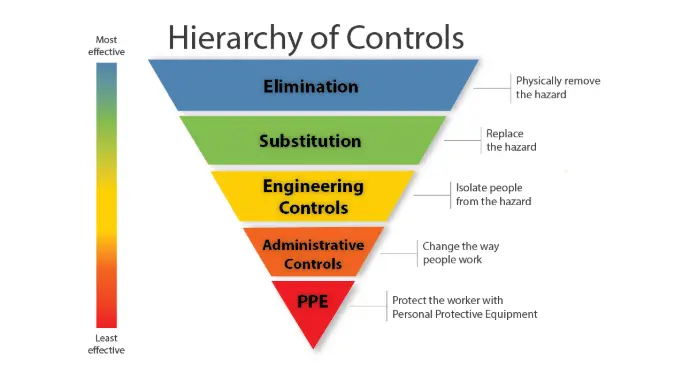
The Hierarchy of risk controls is fundamental to machine design; the first choice must always be to eliminate the hazard (i.e. design it out of the system), followed by substituting the hazard for a lower risk hazard, followed by engineering controls (e.g. interlocks, guarding), followed by administrative controls (instructions to operators) and finally, reliance on PPE.
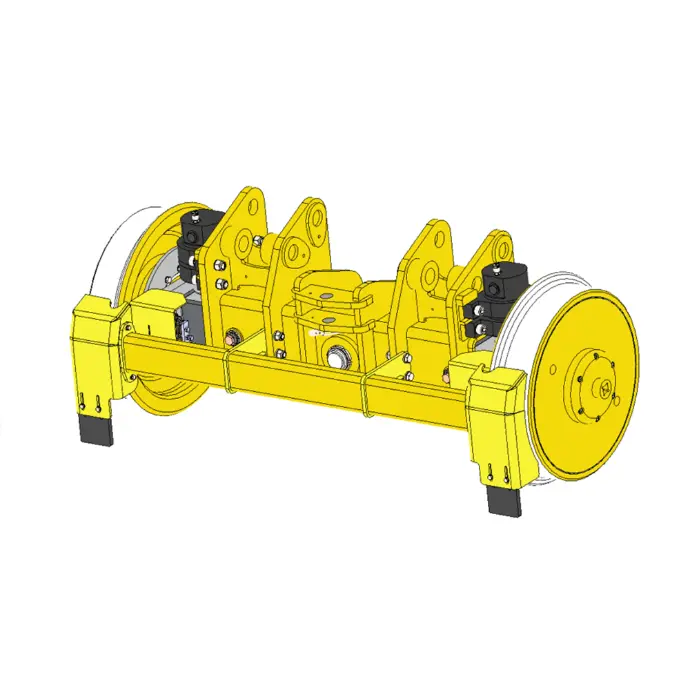
AJH Plant demonstrated application of this principle by, for example, their use of guarding around rail wheels. Rather than relying on PPE (steel-toe boots) or administrative controls (exclusion zones), they engineered guards around the rail wheels to prevent operators from trapping their feet between rail scrapers and rail wheels.
An important part of the review undertaken by AEGIS is to check that, where administrative risk controls are used, they are transferred to the relevant party; i.e., if controlling a risk relies on someone doing something, that person needs to be told to do it. To ensure that all administrative controls are transferred to the relevant party, AJH Plant identified, in their risk assessment, who is responsible for carrying out each administrative control and briefed them on the need for each control. For example, they identified that the requirement to maintain exclusion zones is briefed to all railway staff in the Lifesaving Rules and the Plant Manual, and that the requirement to measure brake force at regular intervals is briefed to maintenance staff within the machine’s maintenance plan.
All machinery must be CE-marked and declared by the manufacturer as compliant with the Machinery Directive. This is a “self-certification” process, which, in other industries, is often not verified by a 3rd party. As part of Product Acceptance, AEGIS confirms that the manufacturer has followed a suitable process to ensure that the product complies with the Machinery Directive. AJH Plant chooses to do this by producing a clause-by-clause assessment against the applicable Harmonised Standard, EN 15746-2. Whilst AEGIS did not review the technical content of this checklist in detail, obtaining evidence that it had been done, and spot-checking a small sample of the checklist, provided evidence that AJH Plant has followed due process in applying a CE mark to the machine.
As
part of the PA site visit, the applicant is required to demonstrate that the
machine can be recovered off-track following a power failure. Recovering the
machine into gauge is achieved using an auxiliary electric pump. To allow the
machine to be towed by a rescue vehicle, both pairs of rail wheels must be disengaged from the road wheels; however, in normal operation, this is prevented
by on/off-tracking interlocks. Initially, disabling the on/off-tracking
interlock required an operator or fitter to go under the machine and modify the electrical circuits. During the site visit, AJH Plant identified
that this increased the time required to recover the machine and posed a risk that the system would not be reverted to its correct configuration
following recovery. AJH Plant re-designed the system so that the
on/off-tracking interlock is overridden by the RCI override. As the RCI must be
overridden to return the machine to gauge, this removes the need to access the underside of the machine. Further, an overridden RCI is immediately
obvious to an operator and machine controller, hence the risk of the system not
being reverted to its correct configuration following recovery is significantly
reduced. The event is also captured in the RCI data logger.
Because the machine is designed to undertake digging and handling, the Network Rail occupational health team requested that the protection against ballast dust be reviewed. AEGIS applied the requirements set out in the Network Rail Plant Manual: any machine that has the potential to generate ballast dust must comply with the cabin filtration requirement specified in EN 15746-2. As AJH Plant had generated an EN 15746-2 technical file as part of their CE marking and had already identified that the machine could be used in dusty environments, they had evidence from the machine OEM, Komatsu, to demonstrate the filtration system's compliance. They also confirmed that, to preserve the integrity of this system, they had not made any new openings in the cab during the conversion to an RRV.
Allan J Hargreaves Plant Engineers Ltd
Following 35 years in the plant and equipment industry, Allan J Hargreaves Plant Engineers Ltd (AJH Plant) began producing its own Road Rail Vehicles in 2018. The Rail Raider excavator/crane was closely followed by the Rail Cyclone drainage/jetter unit; after AEGIS review, both machines were granted Product Acceptance. Liebherr GB also commissioned AJH Plant to certify machines for the UK, which provided the opportunity to gain Product Acceptance for the Liebherr 922 excavator/crane; again, the PA review was undertaken by AEGIS.
The Rail Rascal
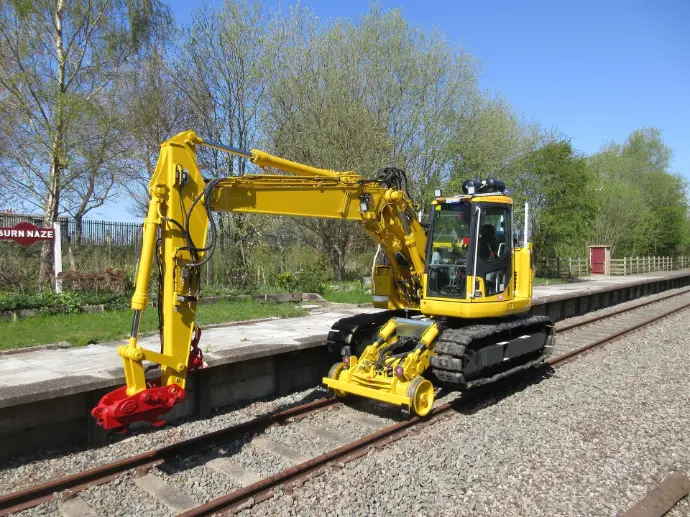
The Rail Rascal is a smaller excavator/crane optimised for
both lifting and digging capabilities. The offset boom provides the range of motion required for trench and drainage excavation, whilst the integrated RCI ensures stability and safety during lifting.
Submission and Certification
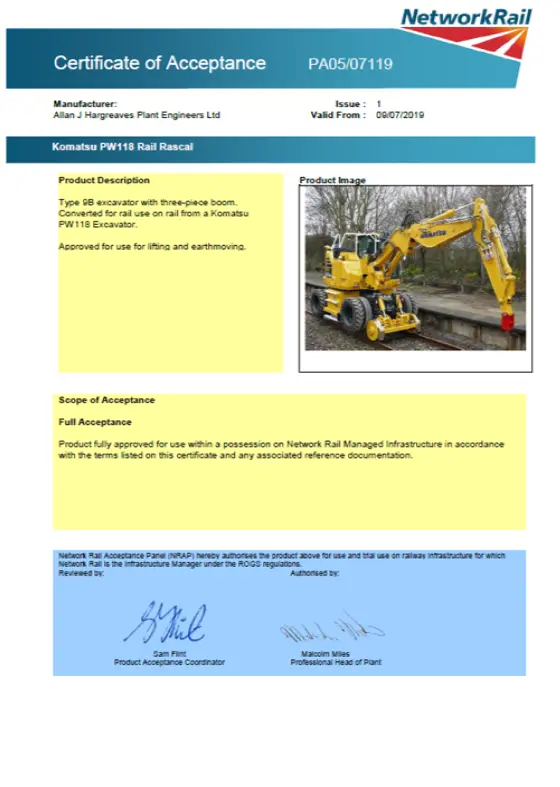
Following the demonstration of compliance with the 26 PA requirements, AEGIS produced a summary report and a draft certificate, including a recommendation for full product acceptance.
The
report provided an overview of the machine, a summary of the review work
undertaken, and a description of the hazard identification and risk assessment
processes employed by AJH Plant. On review of the report, Network Rail issued a
full Product Acceptance certificate for the machine.

Sam Bear, Lead Engineer