Development of Liebherr wheeled road rail vehicles
Expanding the line-up of AJH Liebherr road/rail wheeled excavators
Following the popular Liebherr R920, and the recent introduction of the RH925 (see Development of Liebherr RH925), Allan J Hargreaves Plant Engineers (AJH) has continued to expand its line-up of Liebherr road/rail excavators. While previous machines have been tracked, the two new machines currently in development are both wheeled.
With the expanded product range comes a new classification system: R for tracked machines and A for wheeled machines, which is consistent with Liebherr‘s own classification types. This is then followed by an H for Hargreaves (AJH), indicating rail machines. The number 9 indicates an excavator, followed by the machine's weight. Therefore, the previously discussed RH925 is a 25-tonne, tracked rail excavator. The new AH921 and AH933 are both wheeled machines, weighing 21 and 33 tonnes respectively. Note, the 32-tonne tracked R920 will retain its current name for the time being.
While AJH converts excavators from various manufacturers into road/rail vehicles, its relationship with Liebherr is particularly close. Additionally, AJH customers have shown a strong interest in Liebherr products with the main drivers being performance, reliability and longevity. The Liebherr A924 Rail is a midweight wheeled machine with Liebherr-designed railgear. AJH modifies this machine to UK specification for Liebherr, including fitting and calibrating the Rated Capacity Indicators (RCIs) and Movement Limiting Devices (MLDs). With tracked machines and midweight wheeled machines already covered, AJH identified gaps for lightweight and heavyweight wheeled Liebherr machines. So, the AH921 and AH933 projects were born.
Working with Liebherr, AJH identified 95 kW and 115 kW platforms for the lightweight and heavyweight machines, respectively. Various bespoke modifications and upgrades were then chosen and developed with Liebherr to optimise the machines for rail use.
Common design features.
AJH designs, manufactures and installs the railgear and rail control systems for both machines. They use a friction drive system, with the road wheels providing traction to the rail wheels. Independent park and service brake callipers on each rail wheel provide direct braking of the rail wheel with a high level of redundancy. A floating axle allows the machine to negotiate track features, while hydraulic axle locks can stiffen the suspension to improve lifting capability when stationary. The AJH control system acts as the operator interface with the rail systems and gives the machine owner remote access to machine data.
AH921 - the manoeuvrable digging and light lifting machine
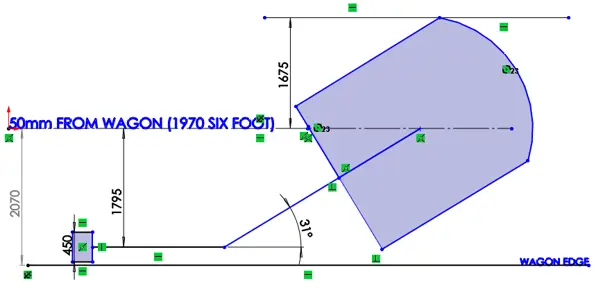
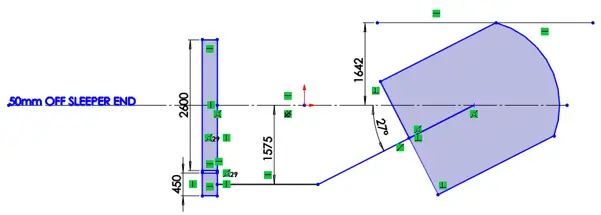
With a number of the traditional road/rail Mecalac 14MBX and MXT machines reaching the end of their service life, there is demand for compact, manoeuvrable excavators optimised for digging operations. Customers were looking for a machine that could dig drainage channels with a 450mm bucket, in a tunnel, with a spoil wagon on the adjacent line.
With a Liebherr offset boom selected, various digging scenarios were modelled to assess the machine's reach and tailswing against the tunnel dimensions and customer requirements. To keep the tailswing as short as possible, no additional piggyback counterweight was added. However, to improve lift capacity and ensure the machine can still on-track a rail trailer, additional weight has been added to the existing counterweight structure. The toolboxes have also been added to the chassis.
The Liebherr blade mount assembly is used to mount the railgear. A Finite Element Analysis (FEA) was undertaken on the railgear design, as well as the entire chassis, to check the structural integrity when in rail mode. This is for both proof loading and fatigue analysis. To maximise manoeuvrability when using the MLD to protect tunnel walls or open lines, the offset boom is fitted with a rotary encoder. This means the MLD always knows the exact position of the boom and can allow the full range of movement. This is unlike simpler systems that assume a worst-case position, even when the boom is not fully offset, which can lead to overly limited movement.
AH933 - the heavy lifter
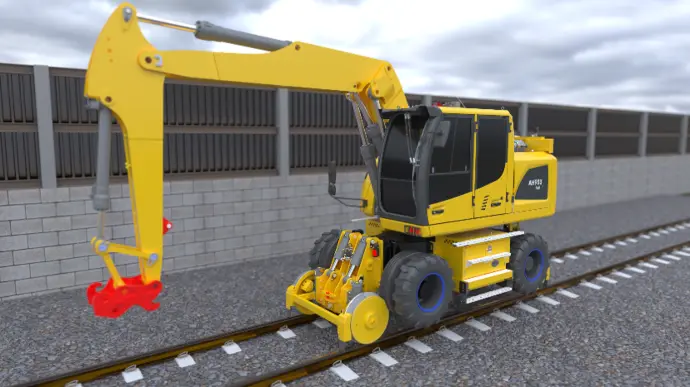
In collaboration with Liebherr, the base platform is being heavily customised by AJH for use as a UK specification road/rail machine. It will be fitted with a ROPS-certified
two-person cab, which will provide safe transport for a second person if required. Additionally, a custom boom has also been designed to optimise lifting per formance.
For maximum lifting capability the machine weight has been achieved through a combination of extra counterweight mass, heavyweight toolboxes, foam-filled tyres,
and strategically located weight within the railgear design.
To further optimise the machine for lifting, variants have been designed with an interchangeable 5.5-metre dipper and the option for underslung dipper hydraulic rams. Excavators are generally optimised for digging, so the extension stroke of the cylinder - which is more powerful than the retraction stroke - pushes the dipper down into the ground and towards the cab. By moving the cylinder to the underside of the boom, the extension stroke of the cylinder pushes the dipper upwards, improving the machine’s lifting power.
Next Steps
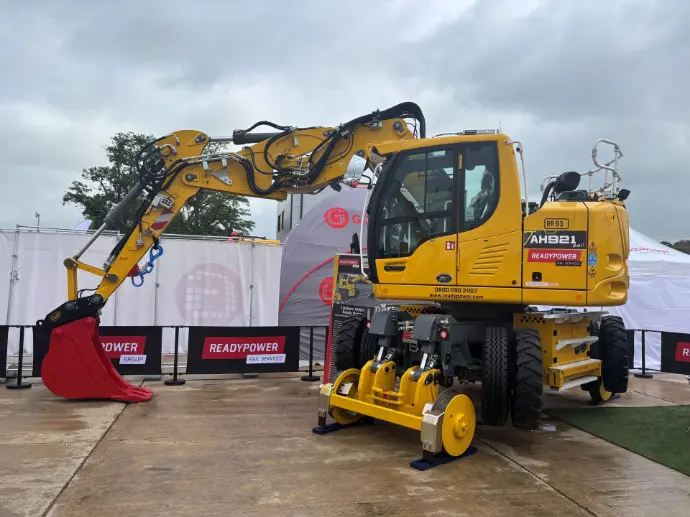
The first AH921 is currently in production. Once the build is complete, it will move to AJH’s dedicated test and calibration team. It will then be commissioned and calibrated, including tip testing for setting the machine’s safe working load, before a final set of compliance tests is undertaken. If you keep your eyes peeled, then you may be able to spot the machine on display at this year’s Rail Live exhibition!
The AH933 is moving from concept design into detailed design. The custom boom has been fully designed and validated, and work can now begin on detailing the railgear and associated systems. These will then be validated through FEA, prior to the machine entering production.

Sam Bear, Lead Engineer